






































Schedule

Type | Day | Time | Place | Start | Lecturer |
V2 | Mo | 16:00-17:30 | AH IV | October 29 | |
Ü1 | We | 10:00-11:30 | AH II | November 07 |
News
- (New) These are the dates for the oral exams:
Date | Time | Name |
19.02.2008 | 09:00 – 09:30 | Muhammad Ali |
09:30 – 10:00 | Mudassir Rasool | |
10:00 – 10:30 | Martin Lang | |
10:30 – 11:00 | Christian Dernehl | |
26.02.2008 | 09:30 – 10:00 | Tim Kosse |
10:00 – 10:30 | Hussein Hamid Baagil | |
10:30 – 11:00 | Aleksandar Bojinović | |
11:00 – 11:30 | Ratna Widyastuti | |
11:30 – 12:00 | Leonid Pishchulin | |
12:00 – 12:30 | Önder Babur | |
26.03.200 | 13:00 – 13:30 | Teena Mary Mohan |
- The oral exam will take place on tuesday 26.02.2008 at our chair (precise times will be announced later on this page). If you want to participate in the exam and fulfill the requirements (50% of the points from the exercises and (at least) onesummary of a leacture) please write an email to Carsten Kern.
- For students which are close to but below 50% of the points in the exercises we offer to do a second lecture summary to improve their score from the exercises. If you are interested please write an email to Carsten Kern to fix a date for doing a second summary.
- There will be a lecture on friday, 11.01.2008 (AH V) from 13:30 to 15:00 (this lecture is a replacement for the lecture on monday the 14.01.2008)
- There will be no lecture on the 14.01.2008 and 16.01.2008
- (IMPORTANT) The assignments have of course to be handed in on 17.12. before the exercise.
- The lecture (17.12.) and the exercise course (19.12.) are swapped (i.e., there will be an exercise on the 17.12. in AH IV at 16:00 and a lecture at 19.12. in AH II at 10:00)
- Assignment 3 Exercise 4: Input: safe MPA A and B>0, Question: is A ∀-B-bounded? (download corrected version)
- Assignment 2 Exercise 4: in G4 p1=p and p2=q (download corrected version)
- Assignment 2 Exercise 5: the "4b" should be a "5b"
- 08.11.2007: a new version of the assignment was uploaded (there was only a change in exercise 4 (third graph)). Please download the new version of assignment 2, now.
- Assignment 1 Exercise 5: can only be solved for MSCs (MSGs) so far because CMSCs have not been discussed in the lecture, yet. Thus, half of the points will be available if you solve exercise 5 for MSCs.
- The LaTeX-template (including an example of using MSCs and graphs in LaTeX) for writing the summaries is now available
- Monday 12.11.2007: no lecture
- Wednesday 14.11.2007: 10:00 AH II, lecture (instead of 12.11.2007)
Notes
- Lecture 1, slide 26: in the example the element e4 « e5 is missing in the relation
Conditions to get a certificate
Students who need to get a certificate (Schein) in the end of the course have to fulfill the following conditions:
- at least 50% of the points of all exercises
- a summary (7-12 pages, written in LaTeX) of one of the lectures (according to the table below)
Assignment of groups to dates for summarizing the lecture
People who want to participate in the exercises of this course have to do a 7-12 page summary of one of the lectures. The actual (preliminary) dates for the students already registered for the exercises are listed below.
- If you are not yet registered, please send an email to Carsten Kern and you will be assigned a date for the summary.
- If your name is misspelled please contact Carsten Kern.
A LaTeX-template for writing the summary is available here.
Preliminary Dates | Name | Name |
05.11. | Thomas Bille | Tim Kosse |
14.11. | Leonid Pishchulin | Aleksandar Bojinović |
19.11. | Muhammad Ali | Rasool Mudassir |
26.11. | Andrea Hutter | Peter Schumacher |
03.12. | Andreas Hackelöer | |
10.12. | Matthias Lederhofer | Alexander Neumann |
17.12. | Teena Mary Mihan | Ratna Widyastuti |
07.01. | Christian Dernehl | Martin Lang |
11.01. | ??? | ??? |
21.01. | Önder Babur | Hussein Hamid Baagil |
28.01. | Teena Mary Mihan | Ratna Widyastuti |
Slides and exercise sheets
Date | Lecture | Subject | Slides | Summary (by students,
with no guarantee for correctness) | |
Oct 29 | 1 | Introduction | |||
Nov 05 | 2 | MSGs | |||
Nov 13 | 3 | CMSCs, CMSGs | |||
Nov 19 | 4 | MPA | |||
Nov 26 | 5 | Realizability | |||
Dec 03 | 6 | Regularity | |||
Dec 10 | 7 | Realizing local-choice MSGs | |||
Dec 19 | 8 | Statecharts | |||
Jan 07 | 9 | Statecharts Semantics (1) | |||
Jan 11 | 10 | Statecharts Semantics (2) | |||
Jan 21 | 11 | Object Constraint Language | |||
Jan 28 | 12 | OCL (Semantics) | pdf (*) |
(*) this PDF was not reviewed
Exercise | Exercise Sheet | Due |
1 | 07.11.07 | |
2 | 21.11.07 | |
3 | 05.12.07 | |
4 | 17.12.07 | |
5 | 09.01.08 | |
6 | 23.01.08 | |
7 | 06.02.08 |
Content and motivation
The Unified Modelling Language (UML) --- more generally, model-driven engineering --- plays an important role in modern software design. The UML basically consists of a set of different notations, each notation focused on a specific aspect of the software system at hand. The aim of this course is to consider some major fragments of the UML: sequence diagrams, hierachical state machines (also known as Statecharts), and the OCL (short for Object Constraint Language).
| |
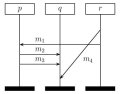 |
- Sequence diagrams specify the interaction patterns between the system components and are a popular elicitation technique for requirements engineering.
| |
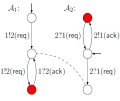 |
- Hierachical state machines and message passing automata are used to describe the behaviour of system components, and are intensively used during the system's design phases, e.g., in the fields of avionics and automotive industry.
- Finally, the OCL allows to specify properties of system components, ranging from pre- and postconditions to invariants and more complex properties.
Aims of this course
The aim of this course is to treat the theoretical underpinnings of the aforementioned UML fragments. In particular, we will present the theories required to:
- Clarify and make precise the semantics of the (treated fragments of the) UML;
- Reason about the basic properties of UML models;
- Algorithms to allow for the verification of such properties on UML models
It is our firm belief (and experience) that a solid theoretical underpinning is of prime importance to obtain automated tools (such as MSCan) that produce reliable, i.e, verifiable results.
Prerequisites
Although the name UML might suggest differently, this is a theoretical course! That is, a solid basis in algorithms and data structures, automata theory, and a bit of theoretical complexity theory is needed to be able to follow this course.
The course will cover for instance, formal semantics (how to precisly lay down the meaning of UML diagrams) and formal verification (is checking certain properties on UML diagrams decidable, and if so, efficiently decidable).
The course will cover for instance, formal semantics (how to precisly lay down the meaning of UML diagrams) and formal verification (is checking certain properties on UML diagrams decidable, and if so, efficiently decidable).
Basic knowledge of the undergraduate courses of the first two years (Vordiplom):
- Automata Theory
- Mathematical Logic
- Discrete Mathematics
- Complexity Theory
Keywords
message sequence charts, message passing automata, realizability, statecharts, model checking, causality, orthogonality, hierarchical modeling, OCL, semantics, undecidability, tools.
Further information
The course will be entirely given in English. The slides and other course material will also be in English. There are no lecture notes (yet); the course material will consist of slides. An examination will take place at the end of the course.
Additional background literature
Jos Warmer and Anneke Kleppe, Object Constraint Language, The: Precise Modeling with UML. Addison Wesley, 2001.
D. Harel and M. Politi, Modeling Reactive Systems with Statecharts: The STATEMATE Approach, McGraw-Hill, 1998.
(The course will however be mainly based on recent scientific papers.)


